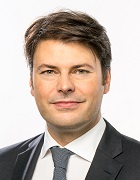
Prof. Dr. Markus Zimmermann
Academic Career and Research Areas
Markus Zimmermann‘s (*1976) research is concerned with design and optimization of complex technical systems, in particular from structural mechanics and mechatronics. He develops methods and optimization techniques that are applied, e.g., in interdisciplinary automotive vehicle development.
Markus Zimmermann graduated from the Technical University of Berlin and the University of Michigan at Ann Arbor, U.S., earning Master’s degrees in Engineering Science and Mechanical Engineering, respectively. He spent one year at the École Polytechnique close to Paris and received his Ph.D. degree from the Massachusetts Institute of Technology (MIT) in Cambridge, U.S., in mechanical engineering in 2005. Before he was appointed university professor at TUM in November 2017, he spent 12 years at BMW in the departments for vehicle body development, vehicle safety and vehicle dynamics. At BMW, he was responsible for several projects to develop and implement new methods for multidisciplinary design with particular focus on uncertainty and complexity.
Key Publications (all publications)
Rodrigues Della Noce, Eduardo; Zimmermann, Markus: Stochastic optimization of convex component solution spaces for arbitrary performance functions. Structural and Multidisciplinary Optimization, 2025.
AbstractWöhr, F; Königs, S; Stanglmeier, M; Zimmermann, M; A quantitative model of hierarchical product design. Design Science, 2025.
AbstractSathuluri, A.; Sureshbabu, A. V.; Zimmermann, M.: Robust co-design of robots via cascaded optimisation. International Conference on Robotics and Automation (ICRA), IEEE, 2023.
AbstractZimmermann, M.; Königs, S.; Niemeyer, C.; Fender, J.; Zeherbauer, C.; Vitale, R.; Wahle, M. On the design of large systems subject to uncertainty. Journal of Engineering Design, 2017.
AbstractZimmermann, M.; J. E. von Hoessle: Computing solution spaces for robust design, International Journal for Numerical Methods in Engineering, 2013.
AbstractIf you wish your profile to be changed or updated please contact Franz Langer.